|
When
the United States Air Force announced the retirement of the F-117A Stealth
fighter by April 2008, Israel approached the US government wanting to
purchase some of the retiring fleet. The United States agreed that Israel
should be allowed to purchase these highly specialized aircraft as long as
their existence was kept secret.
Before
the first operational F-117A was delivered to Israel, a few select pilots
and maintenance crews were sent to Nevada for training and eventually flew
a few missions with the USAF in Operation Red Flag and later in
Afghanistan against the Taliban. Once the F-117A was officially retired in
2008, a few aircraft had already been delivered to Israel for operational
use. The F-117A was renamed the Roo’akh (ghost). The aircraft were flown
in under the cloak of darkness and concealed in hangars while they were
repainted IAF colors & markings with the roundels being subdued to
aide in night operations.
Threats
from surrounding countries started to increase especially Iran after they
tested super long range missiles capable of reaching anywhere in Israel.
Nuclear inspectors were also kicked out of Iran and it was evident that a
nuclear weapons program was in the advanced stages. Time was running out
for Israel and as they had done in the past, a pre-emptive strike to take
out Iran’s nuclear facilities is the only choice for the safety if
Israel and the surrounding countries. Previous strikes against nuclear
facilities pitted highly talented F-16 pilots against the Soviet style
radar defense systems and enemy air traffic controllers. There were times
that the F-16 pilots were picked up by radars and fooled the controllers
which could have easily cost the lives of the entire strike force on those
missions. With the F-117A in the IAF inventory, a deep strike in Iran
would be much more efficient. While not 100% safe, considerably safer than
previous missions.
Click on
images below to see larger images
The
first strike option against the Iranian nuclear facilities was agreed upon
and planning started right away. The Ro’akh is capable of evading the
radar systems used by Iran but there is always a possibility of detection
if sent in alone so a diversion was needed. IAF F-16 fighters flew what
appeared to be training missions near the Iranian border to draw attention
away from the incoming strike force. Electronic jamming aircraft were also
employed to aide in confusing the radar sites. Four F-117’s entered
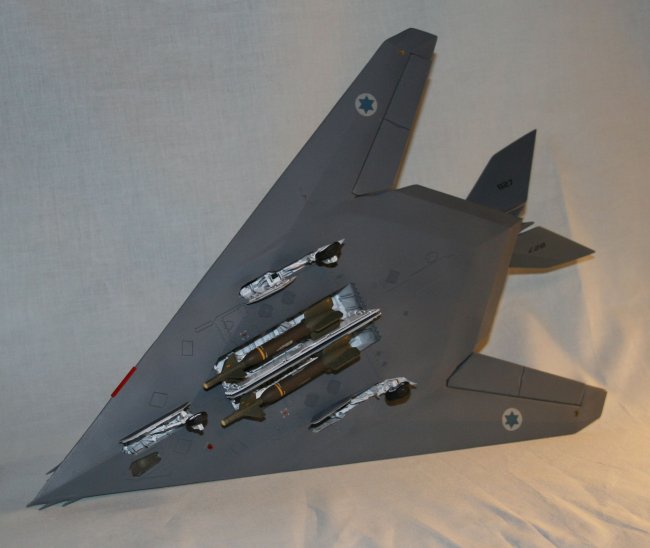
Iranian airspace loaded with a pair of 2000lb laser guided bombs. Once
over the target, the bombs were released with all the critical areas of
the nuclear facility destroyed. All four F-117A aircraft returned safely
back to base without even a scratch. Another successful mission.
The
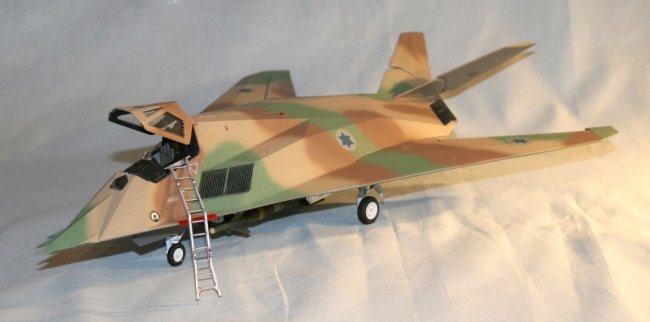
kit is the Monogram “Pro Modeler” Stealth fighter kit. The kit is
fairly simple and a quick build but there are a few gaps to fill. There is
an item on the underside (behind the main gear) where a long protruding
guide pin coming from inside the upper fuselage half needs to be trimmed.
This is not noted anywhere in the instructions. The wheels are molded
“bulged” but are too flat. I built the kit basically OOB except for
the Laser guided bombs which come from Hasegawa weapons, markings and a
scratch built red cover protecting the airframe from accidental damage by
the crew ladder.
Painting
the kit, I used Model master enamels, (lightened Army/Marines sand instead of
using 33531 sand) following the pattern provided by Doncolor of a prototype
desert scheme. The basic deviation was to darken the underside color to Gunship
Gray 36118. For the markings, I painted the Israeli “star of David” roundels
is a subdued, similar to what their helicopters use. Standard warning markings
are from the kit and tail codes from spare decals in the stash. The only real
weathering I did was inside the wheel wells and bomb bays.
The
kit was a fun build, finished in about three weeks. Once I heard about the
F-117A retirement, my first thought was, we should sell them to Israel and how
cool it would look in the F-15I colors.
David
Click on
images below to see larger images
|