|
Lockheed’s AH56a Cheyenne
gunship won the Army’s Advanced Aerial Fire Support System (AAFSS) competition
in 1964. The pusher prop design was technically very advanced and
presented many development challenges to Lockheed. Ultimately most of the
issues were overcome but the contract was cancelled in 1972 due to lack of
political support, interservice rivalry, rising costs and the protracted
development schedule. Aviation enthusiasts still debate the aircraft’s
merits and whether the decision to cancel the program was the right choice.
As an army pilot I was always impressed with the aircraft’s potential and
would have welcomed an assignment flying the
Cheyenne
.
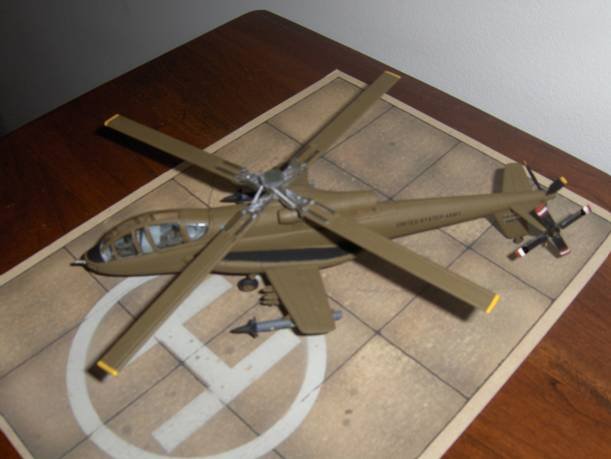
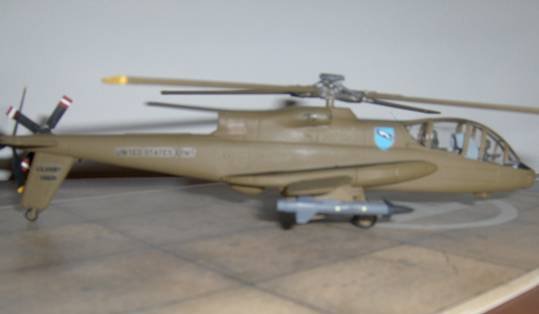
I’ve had the Aurora
kit sitting on the shelf for years and finally decided to build this antique
and say the heck with the $100 it would have fetched on EBay. The
Aurora
kit is typical of most from the late 60s. While it’s no Tamiya “shake
and bake” it went together fairly well. I made a few mods to suit my
“what if” finished version and to correct a few inaccuracies.
I substituted a three-bladed
square-tipped prop for the kit’s very inaccurate pusher prop. Looks Ok
but a little too slender span wise, especially at the root. Left the prop
boss intact (my choice). Also, I should have trimmed the length of the
blades just a bit because if it actually spun it would hit the T/R’s arc.
The kit’s landing gear is
molded with the oleos fully extended as they would be in flight. This
causes the model to sit too high on the ground. I cut all three gear legs
to better represent the almost slightly nose low attitude on the ground.
Click on
images below to see larger images
I filled the sensor turret with
clear glue, and cut the pilot’s pedestal down a bit to lower the overall
height.
I installed a “hot end”
turbine wheel in the engine compartment to fill the empty exhaust hole.
It’s mounted fairly deep in the aircraft at the approximate location where the
engine would be so you can’t see it without a flashlight.
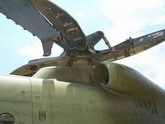
The major mod is to the main
rotor head (MRH). The kit’s MRH is an oversized hunk of plastic that
approximates the first MRH configuration with the unique “spider” control
rod assembly and the overhead stabilizer bar. This design never worked
satisfactorily. The stabilizer was apparently both overwhelmed by inputs
from the MRH and also induced feedback to the MRH.
A much improved “Advanced
Mechanical Control System” (AMCS) was developed with a low mounted stabilizer
below the transmission cowling. The AMCS was much more compact and I tried
to capture this look. Ultimately my very limited modeling skills resulted
in a RH that loosely approximates the look of the AMCS. My main purpose
was to slim down the kit’s RH and the final version at least accomplishes
that.
This “what if” version is
finished in the 1960s/70s Army Field Drab worn by the
Vietnam
era helos with operational decals of the period. The wing stores are what
I had in the spares box, and includes Hellfires (I didn’t have TOWs), and a
fictional load of Bullpup style stand off missiles.
Imagine the aircraft getting
ready for an interdiction mission against a bridgehead, with the Bullpups to
destroy the bridge and the Hellfires to blunt the armored advance. After I
built it with this load out I could quickly see why the Air Force felt
threatened, given the aircraft’s overall performance. It would have
compared fairly well with the A-10’s!!
With apologies to the expert
modelers and IPMS “rivet counters”, I think this vision of what might have
been came out looking pretty good and I welcome your comments. Thanks for
your interest.
Jeff
|