|
_ |
|
1/48 Ki-27 Otsu Type 97 Fighters Part 1 decal sheet |
|
|
Decal sheet product # 48-020 |
![]() |
|
Review by Steve Bamford on Sept 17 2007 |
|
|
-------------------- |
|
|
|
|
|
|
|
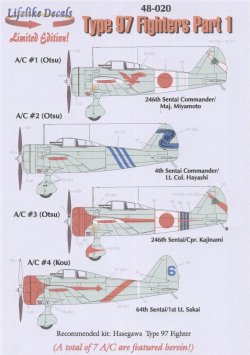
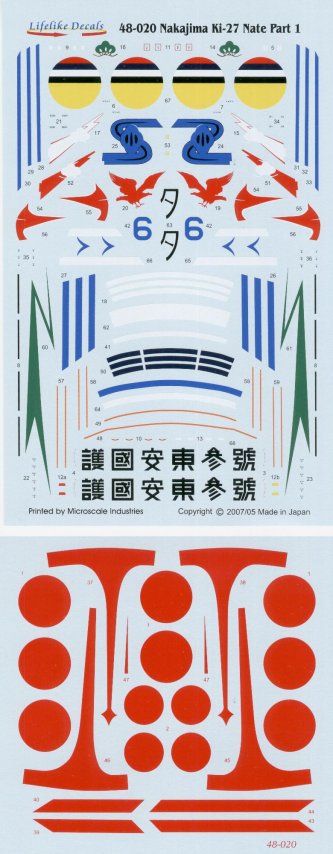
This latest release from Lifelike Decals decal sheet features seven different Ki-27 Otsu Type 97 Fighters. This is Part 1 of a series dealing with the Ki-27 Otsu Type 97 Fighters in Japanese markings from November 1938 to the January 1943. The first plane is a Ki-27 Otsu Type 97 Fighter flown by 246th Sentai Commander, Major Takeo Miyamoto, Kakogawa AB/Hyogo Pref. in December 1942. The overall colour for this plane is a "greenish gray" (gray color with slight green tint, and is slightly lighter than RLM 02 color). Markings include a large red eagle on the side of the fuselage and a white lightning bolt on the tail. The Hinomaru are over white bands on the wings and rear fuselage and the wing leading edges are yellow. You will be painting the white bands and the yellow leading edges. The second plane is a Ki-27 Otsu Type 97 Fighter flown by 4th Sentai Commander, Lt. Col. Saburo Hayashi, Kikuchi AB/Kumamoto Pref. in September of 1940. The overall colour for this plane is a "greenish gray" (gray color with slight green tint, and is slightly lighter than RLM 02 color). Markings include 3 blue diagonal stripes (included as decals) on the sides of the fuselage and wings that strongly indicate Commander's position. Tail markings originated from 4th Sentai's birth place, Tachiarai (litterally translated in english as "washing Japanese sword"), so a mark of a hand protector of the Japanese sword and water stream. At this point in this aircraft's life there were no fuselage Hinomarus applied. |
|
|
|
|
|
The third plane is a Ki-27 Otsu Type 97 Fighter flown by Corporal Susumu Kajinami of 346th Sentai 2nd Chutai, Kakogawa AB/Hyogo Pref. in September of 1940. The overall colour for this plane is a "greenish gray" (gray color with slight green tint, and is slightly lighter than RLM 02 color). Markings include a red engine cowling that extends to a horizontal stripe running along the mid-side of the fuselage. On the tail is a red lightning bolt of the Sentai emblem on the tail indicates Chutai and the 3 fuselage bands are dark blue long red eagle on the side of the fuselage and a white lightning bolt on the tail. The Hinomaru are over white bands with orange outline on the wings and rear fuselage and the wing leading edges are yellow. The white bands and orange outlines as well as the yellow leading edges on the wings will need to be painted. The fourth plane is a Ki-27 Kou Type 97 Fighter flown by 1st Lt. Iwori Sakai, Captain of the 64th Sentai 2nd Chutai, Ertaokou AB/China in November 1938. The overall colour for this plane is a "greenish gray" (gray color with slight green tint, and is slightly lighter than RLM 02 color). Markings include a flash marking on the fuselage is the Sentai emblem, and the red fuseklage and wing bands indicate 2nd Chutai leader, but at this time he was not the leader of the 2nd Chutai. 1st Lt. Iwori Sakai was one of the ebst pilots in the IJAAF with 7 victories in Nomonhan. He later became a teacher at the Akeno Flying School and then a test pilot at the Army Aircraft Evalution Cetter, mainly for the Hien and the Type 5 fighter. He also achieved one more victory while leading a defense fighter unit. The fifth plane is a Ki-27 Otsu Type 97 Fighter flown by M. Sgt. Katsutaro Takahashi of the 59th Sentai 1st Chutai, Hankou AB/China at the end of 1939. The overall colour for this plane is a "greenish gray" (gray color with slight green tint, and is slightly lighter than RLM 02 color). Markings include a large red eagle on the side of the fuselage and a white lightning bolt on the tail and a white band around the rear fuselage. The Hinomaru are over white bands on the wings and rear fuselage and the wing leading edges are yellow. Marlkings on this aircrafgt include a green lighting bolt flash on the side of the fuselage and a Japanese character on the rudder which is the first Katakana character the pilots name. M. Sgt. Katsutaro Takahashi achieved 2 victories in Nomonhan and added a further 7 in Malay and Java to become the top ace in the Sentai, but was killed Dec 14 1942 by a strafing enemy fighter on Timor Island. |
|
|
|
|
|
|
|
Click on images below to see larger images |
|
Photos and text © by Steve Bamford
|
|