|
Lifelike
Decals
|
|
1/48
Ki-27 Otsu Type 97 Fighters Part 3 decal
sheet
|
|
Decal sheet
product # 48-022
|
|
|
Review
by Steve
Bamford on Sept
26 2007
|
|
--------------------
|
|
This latest
release from Lifelike
Decals decal
sheet features seven different Ki-27 Otsu Type 97 Fighters. This is
Part 3 of a series dealing with the Ki-27 Otsu Type 97 Fighters in
Japanese markings from May/June 1939 to March of 1945.
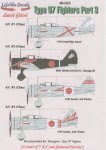
The
first plane is a Ki-27 Otsu Type 97 Fighter (s/n 326) flown by Sgt.
Moritugu Kanal, 11th Sentai, 1st Chutai, Nanking/ China, 1940. The overall colour for this plane is a
"greenish gray" (gray color with slight green tint, and is
slightly lighter than RLM 02 color). Markings include 2 crossing
red diagonal bands on the rear fuselage a white rear fuselage band and a
white diagonal lightning bolt on the tail. Sgt. Moritugu Kanal(as
the wingman of WO Shinohara) was an ace (score 7) already in the
Nomonhan Incident. He moved to the 25th Sentai on sept 1943 and
contributed to fight the Pacific War, finally riding a Hayate in 1945
(aircraft #4 on Lifelike
Decals sheet
48-014) and lived through the war as a 1st Lt with a score of 26.
The
second plane is a Ki-27 Otsu Type 97 Fighter flown by 2nd Lt. Iichi
Yamaguchi, Leader of the 68th Shinbu-tai, Tenryu AB/Shizouka Pref.,
March 1945. The colours for this plane is Dark Green on the upper
surfaces and grey on the lower surfaces with a white fuselage band.
The leading edges of the wings are yellow and will need to be painted.
Markings include a large red with white outline on the forward side of
the fuselage. The Hinomarus on the fuselage have the white outline
painted over in Dark Green. On the tail are the numeral 6 and 8 in
white which denoted the 68th Shinbu-tai and above it is the pilot's
name.
|
|
|
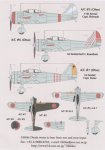
The
third plane is a Ki-27 Otsu Type 97 Fighter of the 13th Sentai, 3rd Chutai,
Taisho AB in Osaka Pref in the summer of 1942. The
overall colour for this plane is a "greenish gray" (gray color with
slight green tint, and is slightly lighter than RLM 02 color). The leading
edges of the wings are yellow and will need to be painted. At the time of
these markings the 13th Sentai was engaged in home defense, so the markings
include a wide white fuselage bands and white bands on the wings with
Hinomarus on the white bands with a large red arrow mark on the side of the
fuselage. On the tail are 3 horizontal red stripes (to denote 3rd Chutai)
with the Japanese character dai (first Japanese character of
Taisho AB) in the center. You'll need to put some white decal sheet below
this dai character as the decal soesn't include that....or use white
paint. It's a slight ommision on the decal sheet. There is a white
#9 on the top of the tail that is missing. The
fourth plane is a Ki-27 Otsu Type 97 Fighter of the 47th Sentai, 2rd Chutai,
Narimasu AB in Tokyo in 1944. The
overall colour for this plane is a "greenish gray" (gray color with
slight green tint, and is slightly lighter than RLM 02 color). The leading
edges of the wings are yellow and will need to be painted. The markings
include a wide white fuselage bands and white bands on the wings with
Hinomarus on the white bands with a large red lightning bolts Sentai emblem on
the side of the tail. On the rear fuselage is 2 vertical bands to denote
2nd Chutai.
The
fifth plane is a Ki-27 Otsu Type 97 Fighter with the 11th Sentai, 1st Chutai,
Manchuria in May-June of 1939. The
overall colour for this plane is a "greenish gray" (gray color with
slight green tint, and is slightly lighter than RLM 02 color). Markings
include a white lightning bolt on the tail denoting the 1st Chutai with a red
band on the red fuselage and a red engine cowling ring. There are 8 red
star kill markings under the canopy.
|
|
| The
sixth plane is a Ki-27 Otsu Type 97 Fighter flown by 2nd Lt.
Kawabata of the 1st Sentai, 2nd Chutai, Harbin, China in January
1941.
The overall colour for this plane is a "greenish gray"
(gray color with slight green tint, and is slightly lighter than
RLM 02 color).
Markings include 2 red and white diagonal bands on the tail.
The rudder is red with two thin red horizontal stripes.
The seventh plane is a Ki-27 Otsu Type 97 Fighter flown by Capt.
Shigetoshi Inoue, leader of the 1st Sentai, 1st Chutai, Nomonhan,
China in Sept 1939. The overall colour for this plane is a "greenish gray"
(gray color with slight green tint, and is slightly lighter than
RLM 02 color).
Markings include 3 red and white fuselage bands. The rudder
is yellow denoting the 1st Chutai with the blavk character na
at the top of the tail. The is a white cherron with red
outline on the side of the forward fuselage. There is red
and white on the wheel covers included as decals although
considering the compounded curves on the wheel covers....painting
the the white part may be easier.
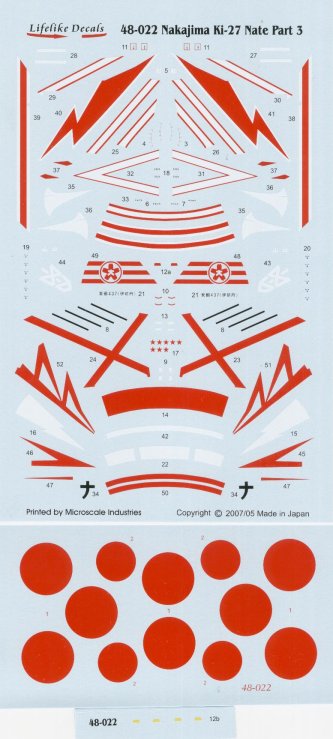
The quality of
these decals is of very good quality. The decals themselves
are clearly printed and in perfect register on 3 decal sheets. Some decals come in 2 layers to ensure perfect
registration. You also get 2 full pages of text telling about
each of the aircraft. The instruction sheets show the
placement of all the decals.
You can purchase these
decals either directly from Lifelike
Decals at
fax number is +81-3-5680-6733, and e-mail is lifelike@eos.ocn.ne.jp.
or from HobbyLink Japan.
Other shops that
stock Life like Decals are *Hannants/UK, *Mister Kit/Italy, *Revi
(publisher)/Czech Republic, *SkyGrid/Canada, *Roll Models/USA,
*Great Models Webstore/USA, *FlightDecs/Canada,
*Victory Models/USA
*M & Models/USA, *Zed
Hobbies/Australia,
*AB &S Enterprise/Australia, *Desert Miniature/USA
Yet
another very nice Ki-27 sheet with some excellent aircraft marking
to choose from
Steve
I
would like to thank Lifelike
Decals for
providing me with this review sample. |
|
|
|
Click on
images below to see larger images
|
|
Photos and text © by Steve
Bamford
|