|
While
some designers choose to do away with the fuselage and the tail and create a
“flying wing”, others choose to eliminate the wings and create a lifting
body. That was the choice of William Horton, from
California
and Vincent Burnelli –see a previous article here: http://www.internetmodeler.com/2008/february/aviation/burn.php
Both of them shaped the fuselage as a wing section.
Another model of a lifting body -the Wainfan Facetmobile- to further illustrate
the concept in a different approach can be seen here:
http://www.aircraftresourcecenter.com/Gal7/6001-6100/gal6099-Facetmobile-Stern/00.shtm
The
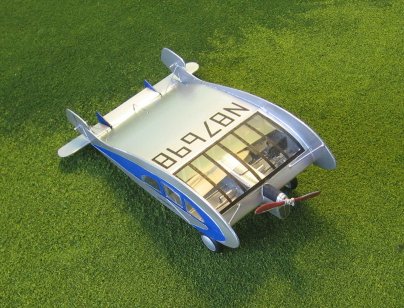
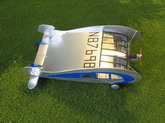
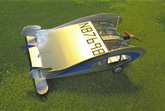
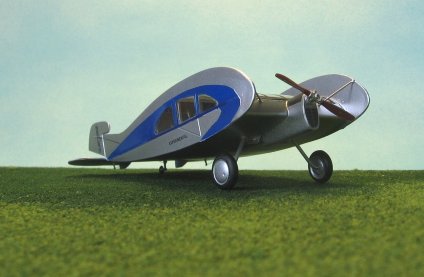
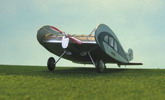
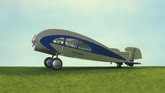
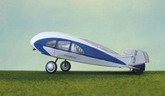
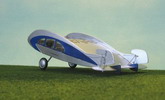
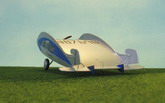
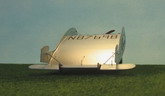
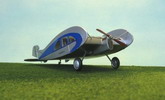
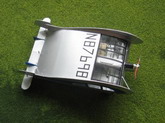
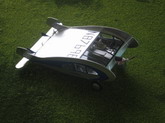
Horton design featured large “endplates” –apparently described as
“sealers”- along the fuselage/airfoil to improve its efficiency. A number of
control surfaces can be seen at its rear end: a central, finned elevator and two
surfaces on the sides that look like elevons (elevator+ailerons). Two fins and
rudders are integral with the endplates. It is of notice that the concept of
lifting body in this case was linked to the “roadable” plane too, since it
was suggested to develop such machine later on. The design can be also described
as being of “negative aspect ratio”, since its span is less than its length,
roughly a 0.5 to 1 ratio.
Click on
images below to see larger images
And perhaps
we should clear some recurrent confusion: William Horton was an American
from
California
, while the Horten (with “e”) were brothers from the nazi
Germany
that later got a free-pass to
Argentina
for a while. The Horten Bros. designed a number of flying wings and
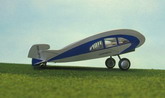
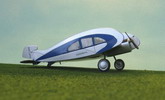
William Horton, as said, worked on the concept of lifting bodies, creating
first the plane which model is here depicted, and later a more
futuristic-looking, twin-engine bigger machine also called the Horton
Wingless.
William
Horton associated with Howard Hughes, a joint-venture that apparently
didn’t work out very well due to the iron grip of Mr. Hughes.
Unfortunately, Hughes stalled in every possible way the development and
sales of the Wingless. Shame on you Howard.
Nevertheless the prototype achieved some flight and its beautiful lines
were preserved in a few images.
Every
one of the strange, out of the ordinary models you enjoy –I hope- in these
articles takes not only the time and effort of the scratchbuilding, but also the
energy spent on the research phase. Data has to be retrieved from the most
inaccessible crags of the Net or the most arcane and dusty libraries. In many
occasions friends and fellow modelers also come to the rescue. To resort to
magic, incantations, invocations and potions is not uncommon, nor is some
nudging and prodding to secret societies and hidden brotherhoods to be able to
produce a 3 view or even a blurry photo.
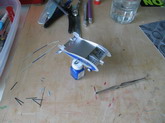
Simple lines on a model don’t necessarily translate into simple construction.
Once the planning and engineering started, it was obvious that once more simple
didn’t mean easy.
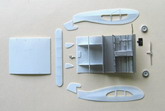
The parts for the model were cut from styrene sheet and rod of
adequate thickness.
One or two parts were modified spare bin sleepers, while wheels and prop –Hartzell
on the original plane- were modified aftermarket items.
Only
a bit of the interior can be seen in the available photos of the real plane,
enough to see the bulk of the long Franklin 68A engine in the middle of the
cockpit/cabin while the shaft protrudes ahead of the fuselage. The pilot seat
seemed to be the located on the left.
The part count was about a hundred when I judiciously stopped
counting.
Although
undiscriminating fellow modelers -whose visual education and taste leaves much
to be desired- dared to call this beauty a “flying toaster”, one thing can
not be denied: imagination was for sure abundant in the blooming 50’s.
Gabriel Stern
Click on
images below to see larger images
|